
CallRail used for call tracking, marketing attribution, lead management, and conversation intelligence. In 2026, the platform helps businesses understand which marketing campaigns generate phone calls, identify promising leads, and measure how effectively their teams convert enquiries into customers.
For businesses that depend on phone calls to win new customers, knowing where those calls originate can make a significant difference. Instead of spending money on advertisements without understanding their results, companies can use CallRail to connect marketing activity with customer enquiries.
But what does CallRail offer, how much does it cost, and is it worth the investment? This CallRail review explores its features, pricing, advantages, disadvantages, and practical uses to help you decide whether it is right for your business.
CallRail Review 2026: An Overview
CallRail is a call tracking and lead engagement platform designed to help businesses measure marketing performance and understand customer conversations. It provides tools for tracking phone calls, attributing leads to marketing sources, recording conversations, and analyzing interactions using AI-powered features.
The platform is particularly useful for service-based businesses where customers often prefer to call before making a purchase. Examples include marketing agencies, law firms, healthcare providers, home service companies, and professional consultants.
Rather than measuring marketing success through website traffic alone, CallRail helps businesses understand which campaigns generate actual enquiries. This information can support better advertising decisions, improved customer service, and more effective lead follow-up.
However, its value depends on how frequently your business receives calls and whether you need detailed information about where those calls originate.

Suggested image: A CallRail dashboard displaying tracked calls, lead sources, and marketing performance.
What Is CallRail?
CallRail is cloud-based software that helps businesses track, record, analyze, and attribute phone calls and other customer interactions to marketing activities.
The platform uses tracking phone numbers and website tracking technology to identify where enquiries come from. Depending on the configuration, businesses can determine whether a call originated from a Google advertisement, an organic search, a website visit, a printed advertisement, or another marketing channel.
CallRail also offers additional tools for form tracking and conversation intelligence. These features help businesses understand not only how customers contact them but also the quality and outcomes of those interactions.
For example, a plumbing company running Google Ads might receive 100 phone calls in a month. CallRail can help identify which campaigns generated those calls and, when configured with suitable lead qualification and conversion tracking, which sources produced the most valuable enquiries.
This makes the platform particularly useful for businesses that want to connect advertising expenditure with measurable business results.
What Does CallRail Do?
CallRail helps businesses understand how marketing generates leads and how those leads interact with their teams.
Its main uses include:
- Call tracking: Identifies the marketing sources associated with incoming calls.
- Marketing attribution: Connects customer enquiries with the campaigns and channels that generated them.
- Call recording and analysis: Helps businesses review customer conversations and evaluate service quality.
- Lead qualification: Uses available automation and AI features to identify potentially valuable enquiries.
- Form tracking: Connects website form submissions with their marketing sources on eligible plans.
- Performance reporting: Provides information about call volume, lead sources, missed calls, and campaign results.
Consider a digital marketing agency managing advertising for several clients. Without call tracking, the agency might know how many people clicked an advertisement but have limited insight into how many subsequently called the business.
CallRail helps close that gap by giving marketers more information about the leads their campaigns generate.
How Does CallRail Work?
CallRail works by assigning tracking numbers to marketing channels or using website tracking technology to associate calls with individual visitor sessions.
The process generally involves four steps.
Step 1: Set up tracking numbers. Businesses create tracking numbers and associate them with advertising campaigns, websites, or offline marketing materials.
Step 2: Connect marketing sources. Depending on the setup, CallRail can use tracking numbers, website scripts, and integrations to associate calls with their originating sources.
Step 3: Collect and analyze interactions. The platform records relevant call information and can provide call recordings, transcripts, and AI-generated insights when the applicable features are enabled.
Step 4: Review reports and improve campaigns. Businesses analyze the data to identify effective marketing channels, assess lead quality, and make better-informed spending decisions.
For example, if a local roofing company receives enquiries from search advertisements and its website, CallRail can help the company compare the calls associated with each source. The business can then investigate which channel produces the most qualified leads.
Accurate results depend on correct configuration, sufficient tracking coverage, and appropriate conversion measurement. Tracking a call does not automatically prove that it resulted in a sale.
CallRail Features
CallRail provides several features designed to improve marketing measurement and lead handling.
1. Call Tracking
Call tracking is the platform’s core capability. Businesses can use dedicated tracking numbers to identify which marketing activities generate calls.
2. Dynamic Number Insertion
Dynamic number insertion can display different tracking numbers to website visitors based on their traffic sources. This helps businesses connect calls with visitor sessions and marketing activity when correctly configured.
3. Call Recording and Transcription
Businesses can record calls where appropriate and use available transcription features to review conversations without listening to every recording from beginning to end.
4. Form Tracking
Form tracking helps businesses measure website form submissions alongside phone enquiries. Availability depends on the selected plan.
5. Reporting and Analytics
Reports provide information about call volume, lead sources, unanswered calls, and campaign performance. These insights help businesses identify patterns and improve marketing decisions.
6. Integrations
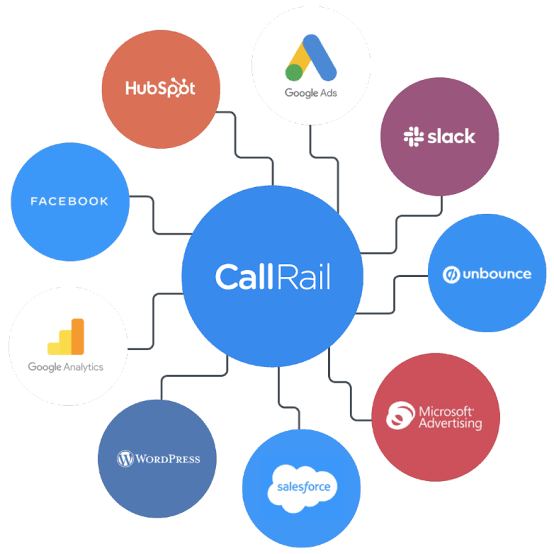
CallRail integrates with supported marketing, analytics, and CRM applications, helping businesses connect lead information with their existing workflows.
7. AI-Powered Insights
Depending on the plan, AI features can provide summaries, sentiment analysis, lead qualification, keyword insights, and conversation trends. These tools can help teams review interactions more efficiently.
Together, these capabilities give businesses a clearer picture of how marketing generates leads and what happens after a potential customer makes contact.

Suggested image: A CallRail call tracking report showing calls attributed to different advertising campaigns.
CallRail Pricing and Plans in 2026
CallRail offers several subscription options, with pricing based on the features included and the level of tracking or analysis required.
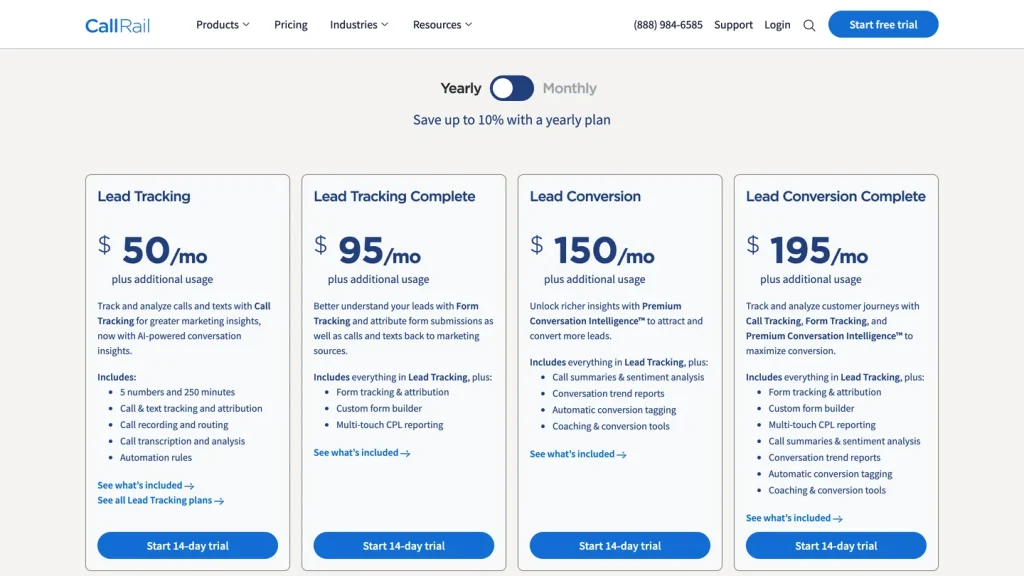
The official pricing page currently advertises the following US-dollar starting prices for its main Lead Engagement plans:
| Plan | Advertised Starting Price | Main Features |
|---|---|---|
| Lead Tracking | $50/month | Call and text tracking, attribution, recording, routing, transcription, and automation rules |
| Lead Tracking Complete | $95/month | Lead Tracking features plus form tracking, form attribution, and multi-touch cost-per-lead reporting |
| Lead Conversion | $150/month | Lead Tracking features plus enhanced conversation intelligence, summaries, sentiment analysis, and conversion tools |
| Lead Conversion Complete | $195/month | Combines lead tracking, form tracking, attribution reporting, and enhanced conversation intelligence |
These advertised prices are in US dollars and may vary with billing arrangements, usage, and additional requirements. The listed plans start with five tracking numbers and 250 minutes, and additional usage charges may apply. Annual billing may offer savings on eligible plans.
For businesses needing automated phone answering, CallRail also advertises an AI Voice Assistant starting at $95 per month, with additional conditions and charges. This is a separate consideration from the core tracking plans.
To confirm current prices, included usage, and plan eligibility, visit the official CallRail pricing page.
Is CallRail expensive? That depends on the value of the leads you receive. If accurate attribution helps you stop wasting advertising money and win additional customers, the subscription may justify its cost. Businesses with very few calls, however, should calculate whether they will use the reporting and analysis features enough to make the expense worthwhile.
CallRail Call Tracking Software
CallRail’s call tracking software helps businesses identify the marketing sources responsible for incoming phone enquiries.
This is particularly valuable when customers research services online but prefer to speak with a person before making a decision.
A law firm, for example, might advertise across several search campaigns. By using separate tracking numbers or appropriately configured website tracking, the firm can better understand which campaigns generate calls.
Call tracking can also help identify missed calls and patterns in call activity. Businesses can use this information to improve staffing, adjust advertising budgets, and strengthen their follow-up processes.
However, tracking numbers need to be configured carefully. Incomplete tracking can create gaps in reporting, while inaccurate conversion data can lead to poor marketing decisions.
CallRail Marketing Attribution
Marketing attribution helps businesses connect leads and conversions with the marketing channels that influenced them.
CallRail provides reporting that can help marketers evaluate the contribution of different sources, including paid advertising and other tracked channels. Its multi-touch attribution capabilities can also help businesses examine multiple interactions along the customer journey.
For example, a customer might discover a company through an online advertisement, revisit its website later, and eventually call to request a quotation. Understanding this journey gives the business more context than simply counting the final call.
Attribution is especially useful for marketing agencies and businesses investing across multiple channels. It helps them compare campaign performance and make more informed budget decisions.
Still, attribution models are estimates of marketing contribution, not perfect proof of causation. Results depend on the quality of tracking data and the model used.
Suggested image: A marketing attribution dashboard comparing leads from paid search, organic search, and other channels.
CallRail Conversation Intelligence
CallRail’s conversation intelligence features use AI to help businesses understand customer calls more efficiently.
Depending on the selected product, these tools can provide transcripts, call summaries, sentiment analysis, keyword insights, and automated lead qualification.
For instance, a home improvement company could use conversation insights to identify common customer questions, understand why some enquiries fail to convert, and recognize opportunities to improve its sales conversations.
Managers can also use these insights to identify coaching opportunities and improve how employees handle leads.
The main benefit is time savings. Instead of manually reviewing every recorded conversation, teams can use summaries and searchable transcripts to find relevant information faster.
However, AI-generated insights are not infallible. Transcription quality depends on call quality and supported languages, and businesses should review important conclusions rather than relying on automated analysis alone. Call recording and transcription must also comply with applicable privacy and consent requirements.
CallRail for Small Businesses
CallRail can be useful for small businesses that rely on phone calls to generate revenue.
Examples include plumbers, electricians, marketing agencies, legal practices, healthcare providers, and other service-based businesses.
A small business can use the platform to understand which advertisements produce enquiries, identify unanswered calls, and evaluate the quality of incoming leads.
This information can be particularly helpful when advertising budgets are limited. Rather than judging campaigns solely by clicks or website visits, owners can examine the calls and leads associated with their marketing efforts.
Nevertheless, smaller businesses should assess their call volume, budget, and reporting needs before subscribing. If most customers contact the business through online checkout or email, the platform’s call tracking features may provide less value.
CallRail Pros and Cons
Before choosing CallRail, consider its main advantages and limitations.
Pros
- Helps identify which marketing channels generate phone calls.
- Provides useful call tracking and attribution reports.
- Offers AI-powered conversation analysis on eligible plans.
- Can connect with supported marketing and CRM applications.
- Helps businesses evaluate lead quality and improve follow-up.
Cons
- Subscription and usage costs can increase with business requirements.
- Advanced features may require higher-tier plans.
- Accurate reporting depends on proper tracking configuration.
- Businesses may need time to understand attribution reports.
- AI-generated summaries and insights may require human review.
Overall, CallRail is most useful for businesses that receive meaningful numbers of phone enquiries and want better visibility into their marketing performance.
How to Get Started With CallRail
Getting started with CallRail is easier when you know what you want to measure.
Step 1: Create an account. Visit the official CallRail website to start a trial or explore the available plans.
Step 2: Choose your tracking needs. Decide whether you need call tracking alone or additional features such as form tracking and conversation intelligence.
Step 3: Set up tracking numbers. Assign tracking numbers to your relevant marketing channels and configure website tracking if required.
Step 4: Connect your marketing tools. Integrate supported advertising, analytics, and CRM applications where appropriate.
Step 5: Review your reports. Monitor call sources, unanswered calls, and lead quality to understand what is working.
Step 6: Improve your campaigns. Use the insights to refine advertising, strengthen follow-up, and make better-informed marketing decisions.
CallRail advertises a 14-day free trial for eligible plans. Review the current trial terms and included features before signing up. 
Suggested image: The CallRail account setup screen or a visual showing the steps from creating an account to reviewing call tracking reports.
Is CallRail Worth It in 2026?
CallRail is worth considering if phone calls play an important role in your sales process and you want to understand which marketing activities generate valuable enquiries.
Its combination of call tracking, marketing attribution, reporting, and AI-powered conversation intelligence can help businesses improve marketing decisions and identify opportunities to convert more leads.
However, it is not essential for every business. Companies with low call volumes or limited marketing needs may find a simpler tracking solution more appropriate.
Our verdict: CallRail is a strong option for service-based businesses, marketing agencies, and companies that want to connect advertising performance with real customer enquiries. Before subscribing, compare the available plans, estimate your usage, and identify the specific decisions you want the platform to improve.
The real value of CallRail is not simply knowing how many people called. It is understanding where those calls came from, which leads deserve attention, and how your business can turn more enquiries into customers.
Leave a Reply